
The term "MVP" gets thrown around in every startup pitch deck, every accelerator program, and every product management course. But here's the uncomfortable truth: most MVPs never lead to a viable product. They either try to do too much and run out of runway, or they ship something so bare-bones that no real user would touch it.
After building SaaS products like clinic management systems and point-of-sale platforms — and helping dozens of clients launch their own — we've seen the same patterns play out over and over. This post breaks down why MVPs fail and gives you a practical framework for building one that actually works.
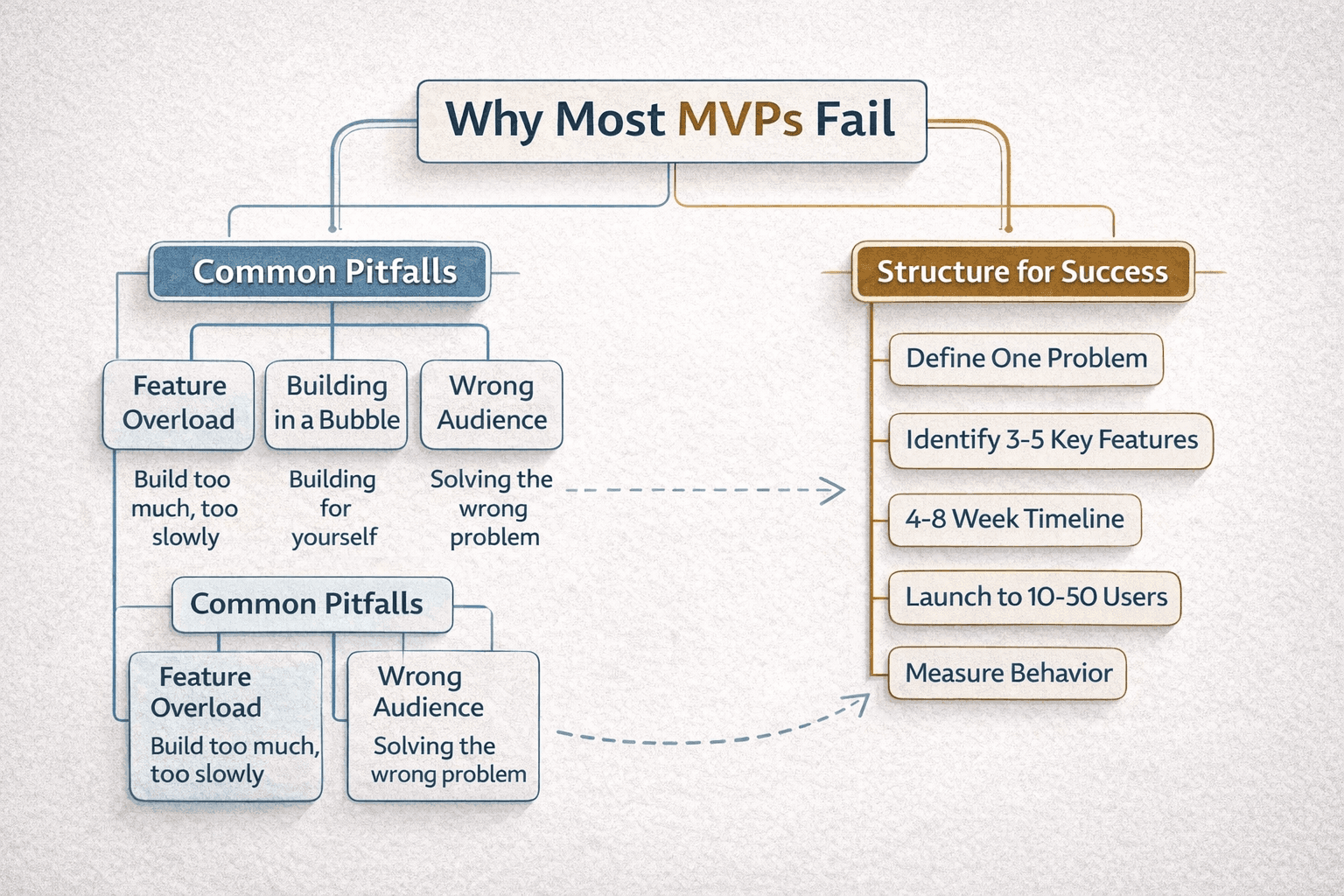
The 3 Reasons Most MVPs Fail
1. The "Minimum" Part Gets Ignored
This is by far the most common failure mode. Founders start with a clear vision of the MVP, but then feature creep sets in. "We just need one more thing before we can launch." Six months and $80,000 later, you have a product that does 40 things poorly instead of 3 things well.
We worked with a client who wanted to build a booking platform. Their initial scope was simple: let customers book appointments online. But by the time we started development, they'd added staff scheduling, inventory management, automated reminders, a loyalty program, and a reporting dashboard. That's not an MVP — that's a full product roadmap disguised as a first release.
The fix was painful but necessary. We cut the scope back to three screens: a public booking page, a provider calendar view, and a simple admin panel. They launched in 5 weeks instead of 5 months. And the feedback from those first 50 users shaped a better product than any amount of upfront planning could have.
2. Building for Yourself Instead of Your Users
Technical founders are especially prone to this. You assume you know what users want because you've experienced the problem yourself. But your experience is a sample size of one.
A common symptom: spending weeks perfecting the architecture, choosing the most elegant tech stack, or building a beautiful design system — before a single potential customer has confirmed they'd pay for your solution. The infrastructure is pristine, but you're solving a problem nobody actually has, or solving it in a way nobody wants.
Your MVP should answer one question: "Will people use this and pay for it?" Everything else — performance optimization, pixel-perfect design, scalable architecture — can come later. If nobody wants the product, it doesn't matter how well it's built.
3. Launching Without a Feedback Loop
Some teams actually ship a lean MVP on time and on budget. Great. But then they just... wait. They put it out there, maybe post about it on social media, and hope users will magically appear and tell them what to build next.
An MVP without a feedback loop is just a demo. You need to actively put it in front of real users, watch them use it, ask them questions, and measure what they actually do (not just what they say they'll do). The "V" in MVP stands for viable — and viability is something you validate, not assume.
A Framework That Actually Works
Here's the process we use at Cantech when building MVPs, whether for our own products or for clients. It's not revolutionary — it's just disciplined.
Step 1: Define the One Problem You're Solving
Not three problems. Not a "platform." One problem, for one type of user, in one specific context.
Write it down in this format: "[User type] struggles with [specific problem] when [specific context], and current solutions fail because [specific gap]."
For example, when we scoped our Clinic SaaS product, the problem statement was: "Small clinic owners struggle with managing daily appointments when they have 2-5 providers, and current solutions fail because they're either too expensive or too complex for a small practice."
If you can't fill in every blank with specifics, you're not ready to build yet. Go talk to more potential users.
Step 2: Identify the 3-5 Features That Solve It
List every feature you can think of. Then cross out everything that isn't directly required to solve the core problem for your initial users. Be ruthless. If a feature is "nice to have," it's not in the MVP.
A useful test: for each feature, ask "If we launched without this, would our target user still get value?" If yes, cut it.
You should end up with 3-5 features. If you have more than 7, you're not building an MVP — you're building a product.
Step 3: Set a Hard Deadline (4-8 Weeks)
MVPs should take 4-8 weeks to build. Not 4-8 months. If your timeline is longer than 8 weeks, your scope is too big. Go back to Step 2 and cut more.
The deadline isn't arbitrary — it's a forcing function. A tight timeline prevents scope creep, forces prioritization decisions, and gets you to market before your assumptions go stale. Markets move fast. The longer you build in isolation, the higher the risk that the world has changed by the time you launch.
We typically structure MVP projects in 2-week sprints: Sprint 1 for core functionality, Sprint 2 for the user-facing flow, Sprint 3 for polish and testing, and Sprint 4 as a buffer for the inevitable surprises.
Step 4: Launch to 10-50 Users, Not 10,000
Your MVP launch is not a Product Hunt campaign. It's a research exercise. You want a small, engaged group of users who match your target profile and are willing to give you honest feedback.
Find them through your network, through communities where your target users hang out, or through cold outreach. Offer free access in exchange for 15 minutes of their time each week. Ten users who talk to you regularly are worth more than 10,000 who signed up and never came back.
Step 5: Measure Behavior, Not Opinions
When you talk to early users, their opinions matter — but their behavior matters more. People will tell you they love a feature and then never use it. They'll say they don't need something and then build a manual workaround for it.
Set up basic analytics from day one. Track which features get used, how often users come back, where they drop off, and what they try to do that your product doesn't support. This data — combined with direct conversations — tells you what to build next.
The Hard Truth About MVPs
Building an MVP is not about building less. It's about learning faster. Every feature you add before launch is a hypothesis you haven't tested. Every week you spend building is a week you're not learning from real users.
The best MVPs we've worked on didn't look impressive at launch. They were simple, sometimes ugly, and missing features that felt essential. But they were in the hands of real users within weeks, and the products they evolved into were shaped by reality, not assumptions.
Your first version will be wrong. That's not a bug — it's the entire point. The question is whether you find out in 6 weeks or 6 months.
What's Next?
If you're sitting on an idea and wondering whether it's time to build, we run Product Discovery Sprints specifically for this. In two weeks, we'll help you validate the concept, define the scope, and walk away with a concrete plan — before you spend a dollar on development.
And if you've already validated your idea and need a team to build it, that's what we do. We've shipped SaaS products from zero to production, and we know where the landmines are.